
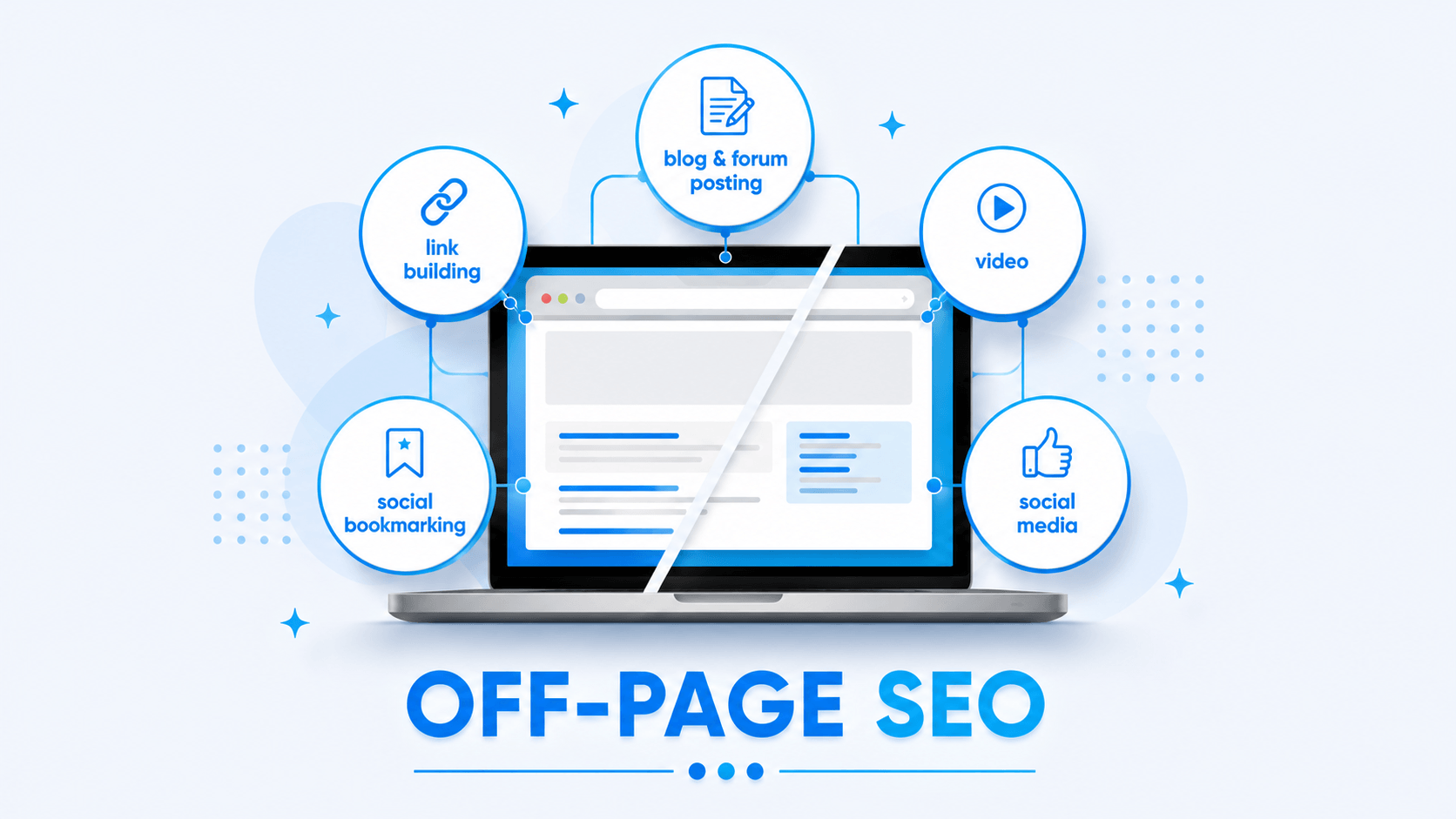
For most of the last decade, off-page SEO meant one thing: get more links. That’s not the full story anymore. Backlinks are still a major ranking input, but Google has gotten noticeably better at reading signals that have nothing to do with a hyperlink: brand mentions, sentiment, and how often your name shows up alongside trusted names in your space.
Links still matter. What changed is that Google got better at reading signals that have nothing to do with a hyperlink: who’s talking about your brand, where, and in what tone. Off-page SEO is still about earning trust from outside your own site. There’s just more going into that trust score than a backlink count now.
This guide walks through every major off-page signal: backlinks, brand mentions, reviews, digital PR, social signals, and AI citation readiness. Each section gives you the overview, and links to a full guide if you want to go deeper.
What is off-page SEO?
Off-page SEO is everything you do outside your own website to build authority and trust. If on-page SEO is what you say about yourself, off-page is what everyone else says about you.
It’s separate from on-page SEO (content, titles, headings) and technical SEO (crawling, indexing, infrastructure), but none of these work in isolation. A backlink pointing at a slow, badly structured page does less for you than the same link pointing at a page that’s already solid on the fundamentals.
Section 1: What’s the difference between On-Page vs Off-Page & Technical SEO
Backlinks
Backlinks are still the most studied off-page signal. Google’s own documentation confirms PageRank, which is built on links, remains part of how it ranks pages. What’s changed is how much that one signal can carry by itself.
Quality has always mattered more than volume, and that gap has only gotten wider. A handful of links from sites with real traffic and topical relevance outweighs dozens of generic directory placements. Worth checking before you celebrate any new link: the page hosting it actually has to be indexed for the link to count at all.
Toxic and Disavow links
Spammy or manipulative links pointing at your site drag down trust signals. Run backlink audits periodically to catch these early. Google’s disavow tool exists for the links you can’t get removed by asking.
Section 2: Backlink Quality vs Quantity: What Actually Matters
Link building strategies
Earning links and building them come from different mindsets. The version of off-page SEO that holds up over time treats links as something that happens to you, not something you go chasing. Publish something worth citing and editorial links tend to follow on their own.
Guest posting
Writing for other sites in your niche in exchange for a contextual link still works, with two conditions. The target site needs a real, engaged audience, not just a domain that’s been around a while, and the pitch needs to fill a gap they don’t already have covered. A rehash of their existing content gets ignored.
Digital PR
Original data, a survey, an industry report: this is the stuff that gets picked up by people who wouldn’t link to generic content. One feature in a publication people actually read can outweigh a long list of low-authority directory links.
Section 3: Guest Posting for SEO: How to Pitch and Land Placements
Brand mentions and unlinked mentions
This is the part most off-page guides still skip past. Google tracks brand mentions even with no link attached. These get called “implied links” sometimes, and Google has described entity-based signals like this in its own published research on ranking.
Worth noting: Brands that get mentioned regularly on review sites like G2 or Capterra, even without a backlink attached, tend to see stronger Knowledge Panel and brand search performance over time. The mention itself appears to function as a trust signal, link or no link.
Sentiment counts here too. A mention on a high-authority site with clearly positive framing outperforms a neutral one, even when the raw mention count looks the same.
Section 4: Brand Mentions and Entity Signals: The Complete Guide
Anchor text and link profile health
Anchor text, the clickable label on a link, tells Google what the destination page is about. An unnatural anchor profile is one of the easier red flags for an algorithmic review to catch. A healthy profile leans heavily toward branded and natural-sounding anchors, with exact-match keyword anchors used sparingly.
- Branded anchors (“according to 4SEOGuide”) should make up the largest share of your profile
- Exact-match keyword anchors (“on-page SEO guide”) should be the smallest slice; overusing these is what triggers manual reviews
Everything else, the natural and generic anchors like “this guide” or “the full breakdown,” fills the space in between.
Section 5: Anchor Text Distribution: What a Healthy Profile Looks Like
Social signals
Google has said directly that likes, shares, and follower counts aren’t a ranking factor. Makes sense; they’re trivially easy to buy. But social media still does real work for off-page SEO, just indirectly.
Content that spreads widely gets seen by more people, and that raises the odds of earning organic links and mentions along the way. Social platforms are also often where Google’s crawlers find new content before they’d find it through normal crawling. The share count itself isn’t the value. What it leads to downstream is.
Section 6: Social Media’s Real Role in Off-Page SEO
Reviews and online reputation
Reviews work as a hybrid signal. They build trust with users browsing your site, and they double as an authority signal for search engines, especially for local and service-based businesses. A steady stream of recent, responded-to reviews on Google Business Profile and the third-party sites your industry actually uses builds the kind of reputation Google’s quality systems reward.
- Respond to every review, good or bad. An unanswered negative review compounds the damage
- Watch sentiment, not just star count. A handful of detailed, specific reviews beats a wall of generic five-star ratings
Section 6: Online Reputation Management for SEO
Digital PR and influencer outreach
Working with someone who already has a trusted audience in your niche tends to produce the exact mix off-page SEO is built on: mentions, shares, and the occasional backlink, all without a cold outreach campaign attached. It’s not purely a social media play. Treat it as an off-page lever.
Section 7: Influencer Outreach as an Off-Page SEO Strategy
E-E-A-T and off-page authority
Experience, Expertise, Authoritativeness, Trustworthiness: none of it can be self-declared. Google doesn’t take a site’s word for being an authority. It needs proof from outside the site, and that proof is almost entirely an off-page job.
Backlinks from sources worth respecting, mentions in genuine industry coverage, real reviews, a citation in someone’s expert roundup. All of it feeds the same evaluation. Your on-page content can claim expertise all day. Off-page is what backs that claim up.
Section 8: E-E-A-T Explained: How Off-Page Signals Build Trust
Off-page SEO for AI search (GEO)
Getting cited inside an AI-generated answer is starting to matter as much as getting linked to. Google’s AI Overviews and tools like Perplexity pull from sources they’ve decided to trust, and off-page authority feeds directly into that trust calculation.
One of the more direct levers here is entity co-occurrence: getting your brand mentioned alongside names your industry already recognizes, link or no link. AI systems map relationships between entities. Show up next to the right names often enough and that shapes how the model classifies your brand.
Section 9: Off-Page SEO for AI Search: Getting Cited by AI Overviews
Common off-page SEO mistakes
Buying links or using link networks
Google penalizes manipulative link schemes specifically, and paid placements are getting easier to spot, not harder, as detection systems improve.
Over-optimized anchor text
A link profile that’s heavily exact-match looks manufactured rather than earned. That’s the exact pattern Google’s spam systems are built to catch.
Ignoring unlinked mentions
Writing off every brand mention without a link as worthless means missing one of the fastest-growing categories of off-page signal right now.
And the last one: treating off-page as a project with an end date. A backlink profile shifts constantly. Links get lost, pages get deindexed, competitors build new ones while you’re not looking. Off-page work that stops being tracked goes stale fast.
Section 10: 10 Off-Page SEO Mistakes That Damage Your Authority
How to audit your off-page SEO
A useful audit tracks growth and quality, not a single backlink number. Run through this on a regular cadence:
- Check your backlink profile’s growth trend over time, not just the total count, using Search Console or Ahrefs
- Search your own brand name and see what mentions exist, and whether any of them are linked
- Check competitor backlink profiles for gaps; sites linking to several competitors but not you are easy outreach targets
Flag anything clearly toxic or spammy and disavow it before it drags down the rest of the profile.
Section 11: Off-Page SEO Audit: Step-by-Step Checklist
Competitor backlink gap analysis
Auditing your own backlink profile only tells half the story. The faster way to find new link opportunities is to look at who’s already linking to your competitors and not to you. If three competitors all have a link from the same industry roundup and you don’t, that’s not a coincidence. That’s a site actively willing to link to companies in your space, and you haven’t asked yet.
How to find the gaps
Pull backlink data for two or three direct competitors using a tool like Ahrefs or Semrush, then look specifically for domains linking to more than one of them. A domain linking to three competitors but not to you is a far stronger signal than a domain linking to just one. The first case tells you the site has a pattern of covering your space. The second might just be a one-off mention that happened to go to a rival.
Turning gaps into outreach
Once you have the list, sort it by relevance before you sort it by authority. A mid-sized blog that covers your exact niche is usually a better target than a huge, generic site that links to everyone. Reach out with something specific: reference the existing article they linked to a competitor from, and explain what your page adds that the competitor’s doesn’t. Generic “we have great content too” pitches get ignored regardless of how good the content actually is.
Run this gap analysis every few months. Competitor link profiles shift, new roundups and resource pages get published, and a gap that didn’t exist last quarter can open up without much warning.
Section 12: Competitor Backlink Gap Analysis: Finding Outreach Opportunities
Frequently asked questions about off-page SEO
Is off-page SEO still mostly about backlinks?
Not anymore. Backlinks are still a meaningful ranking input, but brand mentions and entity signals now carry real weight alongside them. A strategy built entirely around link acquisition is missing a growing share of what off-page SEO actually involves in 2026.
Do social media signals directly affect rankings?
No. Google has said directly that likes, shares, and follower counts aren’t ranking factors. Their value is indirect: visibility on social platforms raises the odds of earning real mentions and links downstream.
How long does off-page SEO take to show results?
Off-page work typically takes longer to show up in rankings than on-page fixes, often a few months at minimum, and the timeline varies a lot by niche competitiveness. Part of the delay is structural: it depends on other people, journalists, bloggers, reviewers, choosing on their own schedule to mention or link to you.
Do unlinked brand mentions actually help SEO?
Yes. Google has confirmed it tracks brand mentions as authority and entity signals even with no hyperlink attached. Mentions on high-authority sites with positive sentiment correlate with stronger Knowledge Panel and AI citation performance.
What’s the biggest off-page SEO mistake to avoid?
Buying links or joining link networks. Google’s spam detection is built specifically to catch manipulative link patterns, and whatever short-term gain you get rarely outweighs the risk of a manual action.
Final thoughts
Off-page SEO rewards the same thing it always has. Being a brand worth talking about. Backlinks are one expression of that. Reviews, mentions, PR coverage, and AI citations are the others, and a strategy that only chases links is fighting with one hand behind its back.
Start with whichever gap is most obvious on your own site. Plenty of content but no backlinks pointing to it? That’s an outreach problem. Mentions everywhere but no reviews or PR coverage? Different gap, different fix. Work through the linked guides above for whichever one applies to you first.
1 thought on “What Is Off-Page SEO? Complete Guide to Off-Page Optimization”
Comments are closed.