
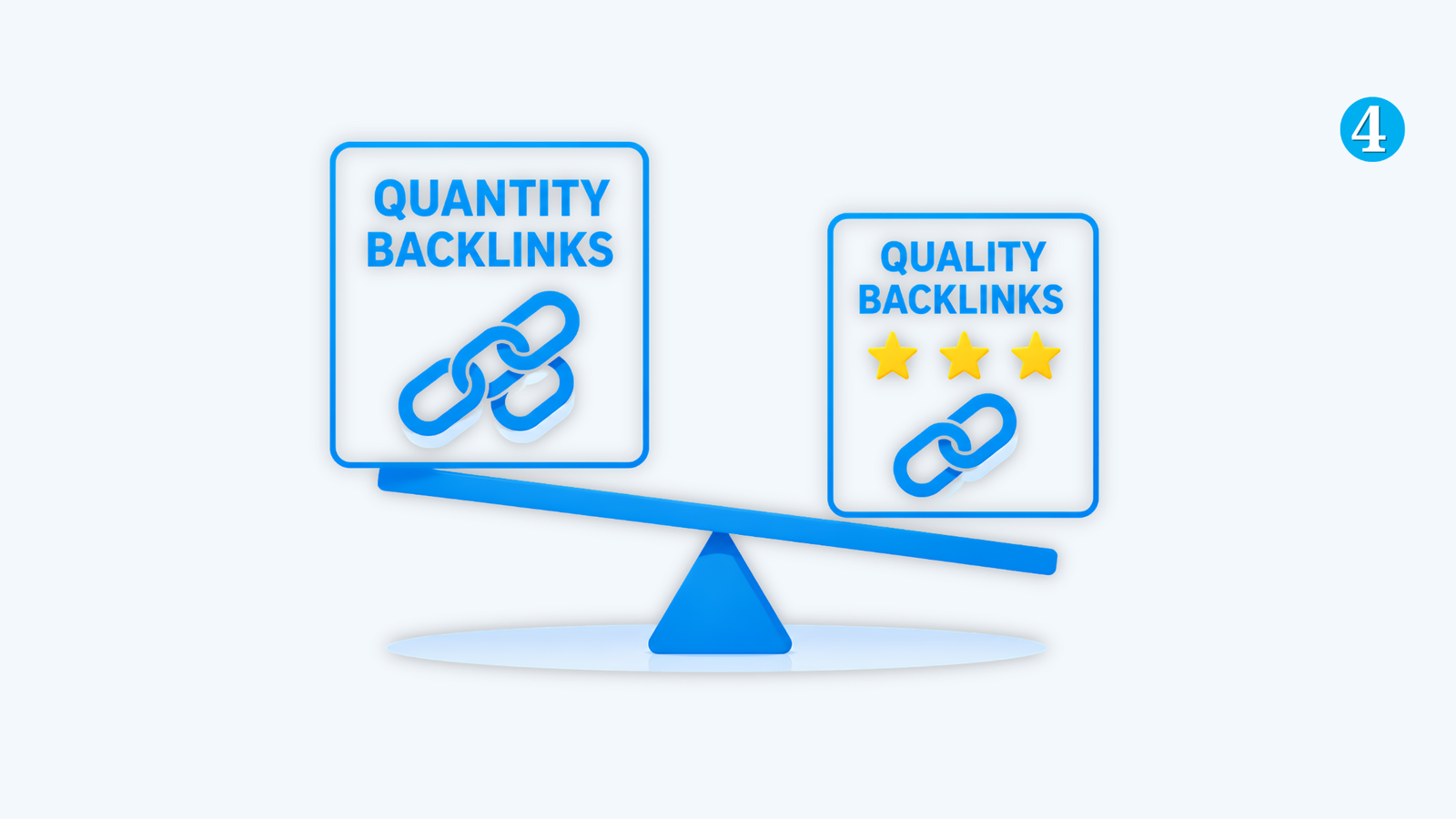
The short answer is quality. The longer, more useful answer is that quantity still matters — just differently than it used to, and in ways most explanations skip over.
This guide walks through what actually makes a backlink valuable, what the data says about how many links you need, and how the answer has shifted now that the same link profile that helps you rank on Google also decides whether AI search tools cite you.
Why Does Backlink Quality vs. Quantity Matter?
Ten years ago, SEO ran almost entirely on quantity. More links meant higher rankings, so directories, blog networks, comment spam, and paid link schemes were all worth doing if they moved the count up. Google’s Penguin update shut down a lot of that in 2012, but it didn’t end the quality-versus-quantity question — quantity never became irrelevant, it just stopped being the whole story.
The current version of this debate is more interesting than the old one. Multiple 2026 ranking-factor studies show the correlation between raw link count and rankings weakening, while the correlation between topical relevance and rankings keeps strengthening. Put those two trends together and you get a simple rule of thumb: ten links from the right sources will usually beat a hundred from the wrong ones — but zero links from either source still means no rankings.
What Makes a Backlink High Quality?
There’s no single metric that defines a quality backlink. It comes down to a handful of factors working together.
1. Topical Relevance
Relevance is the single most important factor when you’re evaluating a backlink.
A link from a site or page that covers topics close to your own is worth more than a link from something unrelated — even if the unrelated site has bigger authority numbers.
If you’ve published an article on technical SEO, a contextual link from an established SEO publication carries more weight than a link from a home-decor blog, no matter how popular that blog is.
Before you chase a link, ask yourself:
- Is the referring website relevant to your industry?
- Is the linking page related to the topic of your page?
- Would the link actually be useful to someone reading the article?
If you can answer yes to all three, the link has a strong relevance case.
2. Authority and Trust
Tools like Moz, Ahrefs, and Semrush each publish their own authority or rating scores.
These are useful for comparing sites side by side, but they’re third-party metrics, not Google ranking factors with official scores.
Rather than fixating on a Domain Authority or Domain Rating number, look at the overall quality of the site that’s linking to you:
- Does it have a genuine reputation in its space?
- Does it publish useful, original content?
- Does it attract real organic traffic?
- Does it earn links from other reputable sites?
- Is it actually relevant to your subject?
A moderately authoritative site that’s highly relevant to your niche is often a better link opportunity than a high-metric site with no real connection to your topic.
3. Editorial Placement
Context matters as much as the link itself.
A link woven naturally into useful editorial content is worth more — for the user and for relevance — than one placed purely for SEO. Compare:
“For a detailed explanation of technical SEO audits, see this guide.”
versus a link buried among dozens of unrelated links in a sitewide footer. The first gives the reader an actual reason to click. The second gives them almost none.
The best link opportunities are usually the ones that would still make sense even if search engines didn’t exist.
4. Link Attributes: Follow, Nofollow, Sponsored, and UGC
Not every backlink decision is a simple follow-vs-nofollow call. Google supports several link attributes:
- nofollow
- sponsored
- ugc
These attributes tell search engines something about the nature of a link. Google treats them as hints, not as an instruction to ignore the link entirely.
Nofollow and other qualifying links still carry real value — referral traffic, brand exposure, discovery, and a more natural, diversified backlink profile.
Quality vs. Quantity: Which Profile Actually Wins?
Take these four simplified backlink profiles:
| Profile | Backlinks | Referring Domains | Relevance |
| A | 200 | 12 | Low |
| B | 50 | 35 | Medium |
| C | 20 | 18 | High |
| D | 8 | 8 | Very high |
The raw numbers alone don’t tell you which page will rank.
Profile D could easily outperform Profile A if those eight links come from highly relevant, reputable sites and the page itself offers meaningfully better content.
At the same time, eight backlinks won’t automatically beat fifty strong, relevant ones just because they’re technically “higher quality.”
SEO was never a simple backlink-counting exercise, and in 2026 it’s even less of one.
How Link Building Has Changed in 2026
In 2026, the same backlink profile that helps you rank on Google also affects whether AI tools cite you.
ChatGPT Search, Perplexity, and Google’s AI Overviews all pull from sources their systems judge as trustworthy — and that judgment overlaps heavily with the link signals Google already uses for rankings.
In practice, one good link now does triple duty: it helps your Google rankings, it improves your odds of being cited by AI tools, and it drives direct referral traffic. That’s why a well-placed editorial link in a respected
publication is worth noticeably more in 2026 than the identical link would have been back in 2020.
A directory link or a low-relevance placement doesn’t get that same lift. It might still show up in a backlink-count tool, but it rarely carries into AI citation signals the way a genuine editorial link does.
Building a Link Building Strategy That Holds Up
The practical version of this debate comes down to a short list of priorities, roughly in this order:
- Start with content worth linking to — original research, real data, an expert guide, something nobody else has answered quite this way. That kind of content earns links without you having to chase them.
- Chase relevance before authority. A topically relevant link from a mid-authority site in your niche will usually outperform a high-authority link from somewhere unrelated.
- Audit your existing backlinks periodically for decay, and reclaim or replace the ones sitting on pages that have gone dead or been deindexed.
- Spread your links across different, independent domains instead of piling more links onto the same few sources.
- Track quality over count. Twenty strong referring domains beat two hundred weak ones on any keyword where your competitors are also playing for quality.
Final Thoughts
The quality-versus-quantity debate has a clear answer in the data: quality is the right filter. The practical application is messier than that answer suggests — a handful of quality links from a single source isn’t enough volume to compete. What actually wins is quality links from diverse, relevant sources, in enough volume to match what your competitors have.
What changed in 2026 is how much work one high-quality link does. It used to just earn rankings. Now it earns rankings, AI citations, and referral traffic all at once — which makes real editorial link building a better investment than it’s ever been.
Full guide: Off-Page SEO Guide: The Complete Checklist for 2026.
1 thought on “Backlink Quality vs. Quantity: What Actually Matters for Your Website”
Comments are closed.