
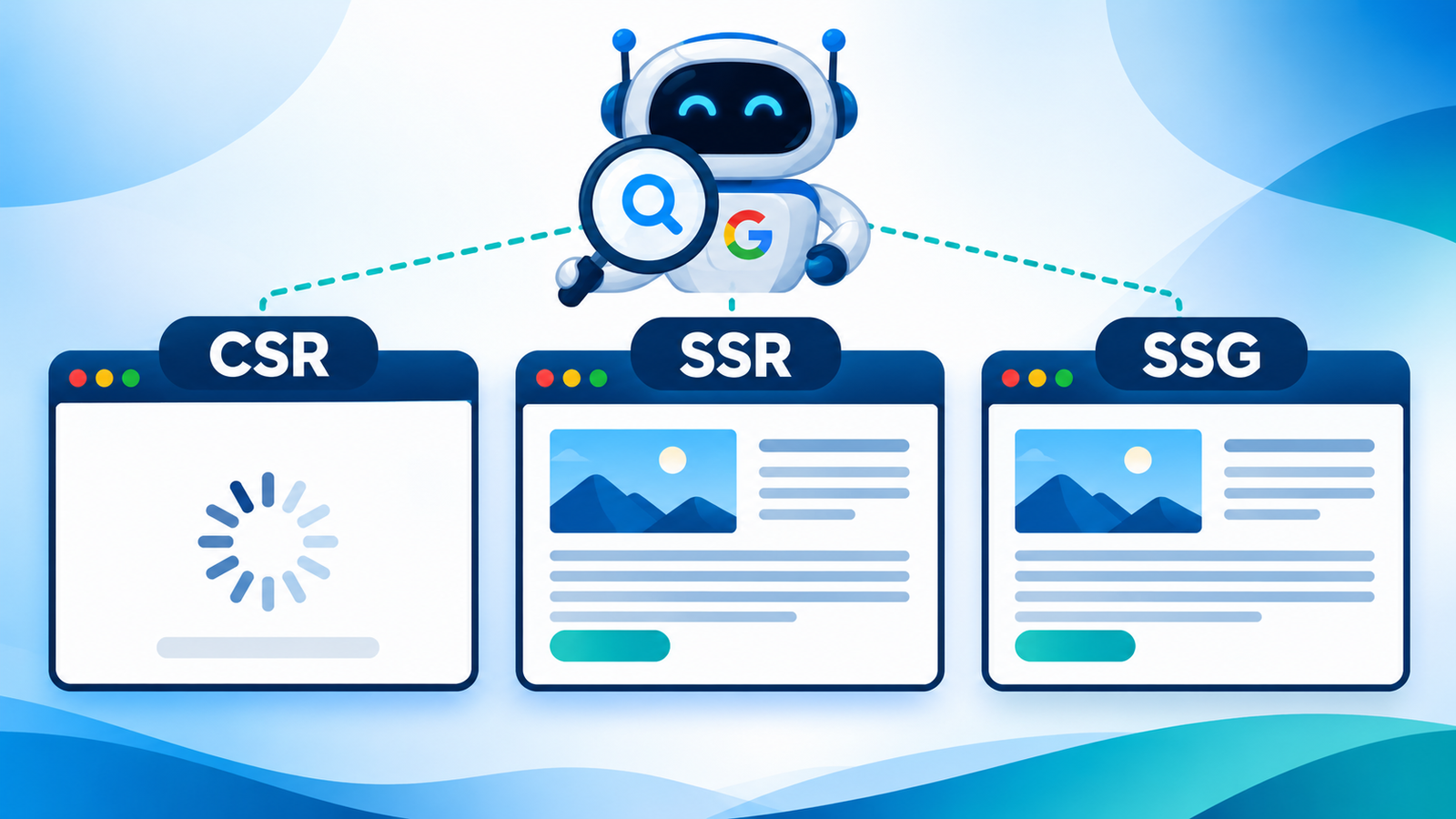
For public pages you want to rank, SSG or SSR is the safer choice. CSR is fine for logged-in apps and a risky default for content that needs to be found. That is the short answer. The more useful answer depends on what kind of page you are building and who needs to read it, including crawlers that are not Google.
This guide explains how each method works, what a crawler actually receives, how to match a rendering method to a page type, and how to check what your own site is serving.
Why Rendering Is an SEO Decision
When a crawler requests a page, the server sends back an HTML response. The rendering method decides whether that response already contains your headline, body text, links, and structured data, or only an empty container waiting for JavaScript to fill it.
Google can run JavaScript. It does so through a rendering step after the initial crawl, and that step uses resources, so it can lag behind. Older guides describe this as two distinct waves of indexing, though more recent writing questions how literally that model should be taken. The practical takeaway holds either way: content present in the first HTML response is the most dependable to get seen, and content that depends on rendering carries extra risk.
Other crawlers matter too. Practitioner tests and several 2026 technical write-ups report that AI crawlers such as GPTBot, ClaudeBot, and PerplexityBot generally read only the initial HTML and do not execute JavaScript. Google’s own AI features draw on Google’s index, so Googlebot’s rendering applies there. If you want to appear in ChatGPT or Perplexity answers, a page that is blank before JavaScript runs is a problem you cannot rely on a crawler to solve.
Client-Side Rendering (CSR)
In CSR, the server sends a near-empty HTML shell and a JavaScript bundle. The browser downloads the script, runs it, fetches data, and builds the page on the user’s device. This is the default output of many React, Vue, and Angular setups.
What a crawler receives from a pure CSR page looks like this:
<body>
<div id=”root”></div>
<script src=”/bundle.js”></script>
</body>
Strengths
- Smooth, app-like interactivity after the first load
- Simple hosting, since the server only serves static files
SEO weaknesses
- Content, links, and meta tags may only exist after JavaScript runs, so indexing depends on a successful render
- Slower first paint, because the browser must download and execute code before showing anything, which can hurt Largest Contentful Paint
- Invisible to crawlers that do not execute JavaScript
Where CSR fits: Dashboards, account areas, and tools behind a login. Nobody needs a search engine to find these, so how crawlers see them does not matter.
Server-Side Rendering (SSR)
With SSR, the server builds the complete HTML for each request and sends it to the browser. The first response already contains the headline, text, links, and meta tags. After loading, JavaScript attaches to the page to make it interactive, a step called hydration.
<body>
<h1>On-Page SEO Guide</h1>
<p>On-page SEO is every change you make directly on a page…</p>
</body>
Strengths
- Content is visible in the first response, so crawlers do not depend on rendering
- Handles pages that change often, such as prices, stock, or personalised content
Trade-offs
- Every request costs server work, so slow servers produce slow pages
- More complex to build and host than static files
- Hydration mismatches, where server HTML and the client’s first render differ, can cause flicker or broken behaviour
Static Site Generation (SSG)
SSG builds pages once, at deploy time, and serves them as ready-made HTML files, usually from a CDN. Nothing is assembled when a visitor or crawler arrives, so responses are fast and the content is fully present.
Strengths
- Fastest delivery, which helps Core Web Vitals
- Cheap and reliable to host
- Complete HTML for every crawler, JavaScript-executing or not
Trade-offs
- Content updates need a rebuild, which becomes slow on sites with very many pages
- Poor fit for content that must change per user or per second
A related approach, incremental static regeneration (ISR), rebuilds individual pages in the background after a set interval. It keeps most of SSG’s speed while letting content refresh without a full redeploy.
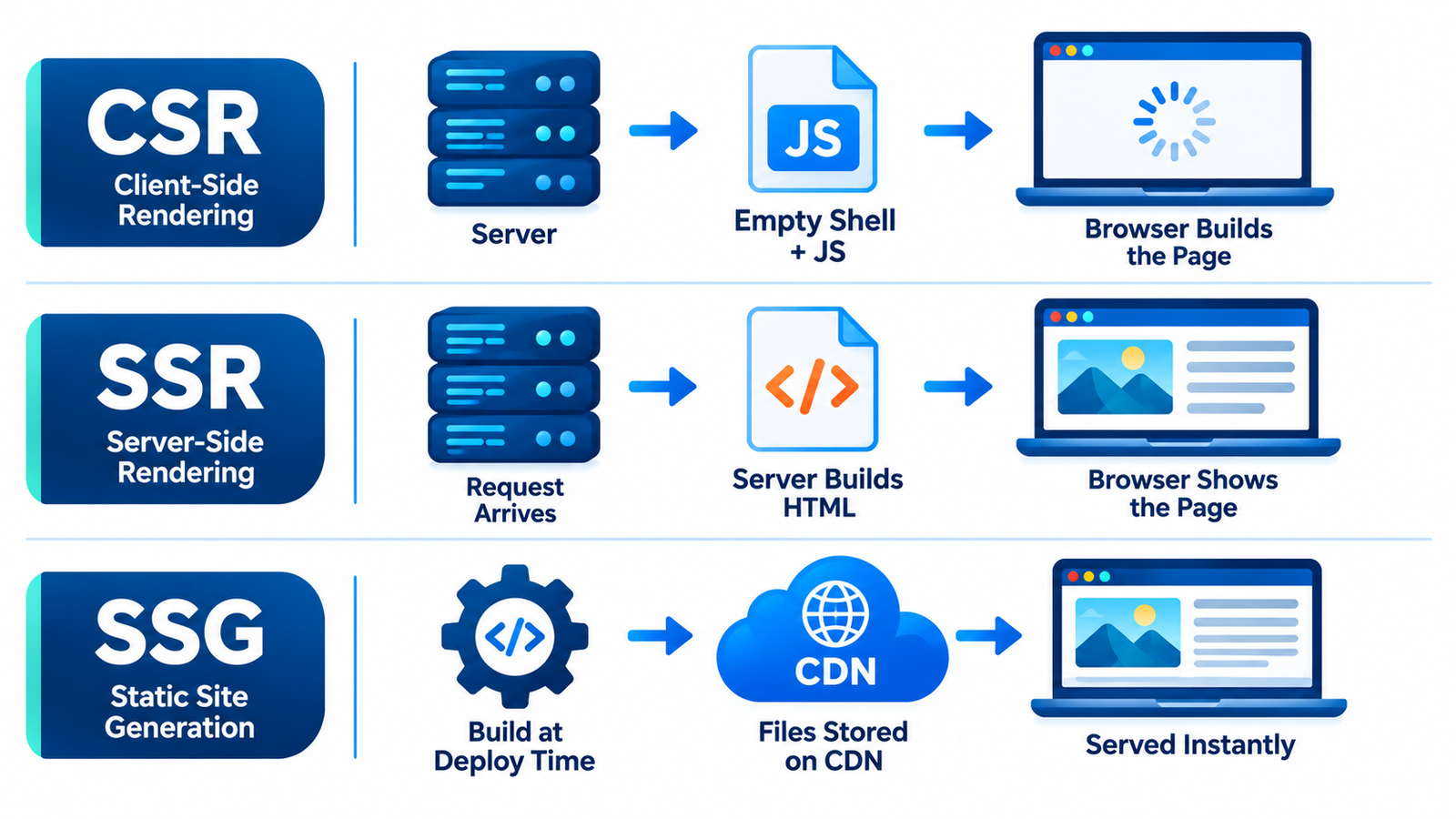
Side-by-Side Comparison
| CSR | SSR | SSG | |
| HTML built | In the browser | On the server, per request | At build time |
| First HTML | Mostly empty | Complete | Complete |
| SEO reliability | Weakest | Strong | Strong |
| Speed | Slower first load | Depends on server | Fastest |
| Fresh content | Easy | Easy | Needs rebuild or ISR |
| Best for | Logged-in apps | Dynamic public pages | Blogs, docs, marketing |
Which One Fits Which Page
Modern frameworks such as Next.js, Nuxt, and SvelteKit let you choose a rendering method per route, so one site does not have to pick a single answer.
| Page type | Recommended | Reason |
| Blog posts and guides | SSG | Content changes rarely, speed matters |
| Homepage and landing pages | SSG | Stable content, fast first paint |
| Product pages with changing price or stock | SSR or ISR | Fresh data without losing crawlable HTML |
| Search result and filter pages | SSR | Content depends on the request |
| Dashboards and account areas | CSR | Behind login, not meant for search |
If you run WordPress, as many content sites do, your pages are already server-rendered: PHP builds the HTML before it reaches the browser, and a caching plugin can make delivery behave much like static files. The rendering debate matters most when you build with a JavaScript framework or add features that load main content through scripts.
Mistakes That Break Indexing
Setting noindex in HTML, then changing it with JavaScript
If the initial HTML contains a noindex directive, Google may skip rendering that page, so a script that later removes it can go unseen. Put the correct robots directive in the server-delivered HTML.
Loading structured data through JavaScript
JSON-LD injected by script depends on rendering and is invisible to crawlers that do not run it. Output schema in the server response instead.
Blocking JavaScript and CSS in robots.txt
Googlebot needs those files to render pages that rely on them. Blocking them can leave Google with a broken view of the page.
Links that are not real links
Navigation built from click handlers rather than anchor tags with href attributes may not be discoverable. Use real links for anything you want crawled.
Relying on dynamic rendering
Serving crawlers a pre-rendered version while users get the JavaScript version was once a common workaround. Google describes it as a workaround, not a long-term solution, and recommends SSR or SSG instead.
How to Test What Crawlers See
- View the page source, not the inspected DOM. If your headline and body text are missing from the source, they depend on JavaScript.
- Disable JavaScript in your browser’s developer tools and reload. Whatever disappears is invisible to non-rendering crawlers.
- Run the URL Inspection tool in Search Console and open the rendered HTML to see what Googlebot produced.
- Fetch the raw response from the command line and look for a phrase from your page:
curl -s https://yourdomain.com/your-page | grep -i “your headline”
If the phrase appears, the content is in the first response. If not, you have a rendering dependency to fix.
Frequently Asked Questions
Can Google index CSR pages?
Yes, Google can render JavaScript and index client-rendered content. The risk is that indexing depends on rendering succeeding and being processed in time, while crawlers that do not execute JavaScript see nothing. Pages meant to rank are safer when content exists in the first HTML response.
Is SSG always better than SSR for SEO?
Not always. Both deliver complete HTML, so the SEO difference is small. SSG is usually faster and cheaper. SSR fits content that must be fresh on every request. Choose by how often the content changes.
Does rendering method affect Core Web Vitals?
Yes. CSR often delays the largest content until scripts finish, which can hurt Largest Contentful Paint. SSG usually performs best, and SSR depends on server response time.
Do I need to worry about this on WordPress?
Usually not for rendering, since WordPress serves HTML from the server. Check instead that page builders or plugins are not loading your main content through JavaScript after the page opens.
Final Thoughts
The best rendering method is the one that puts your content in the first HTML response without costing you speed or freshness. For most public content, that means SSG, with SSR for pages that change per request. CSR earns its place in logged-in products, not in pages you need search engines and AI tools to read.
Whatever you choose, verify it. Open the page source, disable JavaScript, and check the rendered HTML in Search Console. Two minutes of testing settles what a thousand opinions cannot.
1 thought on “CSR vs SSR vs SSG: Which is Best for SEO”
Comments are closed.