
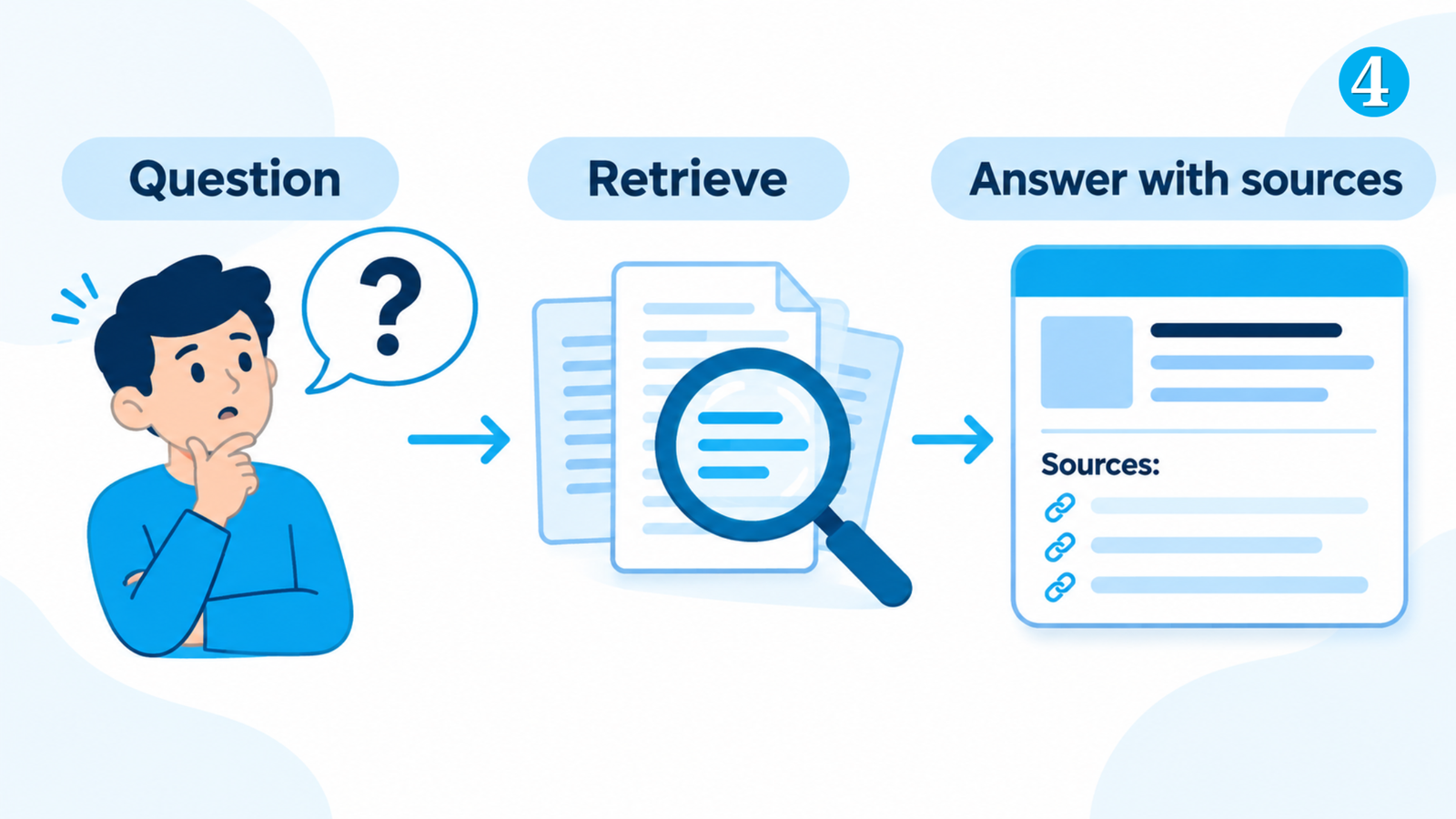
RAG stands for retrieval-augmented generation. It is the technique that lets an AI model look things up before it answers, instead of relying only on what it memorised during training. When an AI search tool names a source, quotes a page, or tells you something that happened last week, retrieval is usually the reason.
For anyone publishing content, that makes RAG the gatekeeper step. If a system does not retrieve your page, it cannot cite your page. This guide explains how RAG works in plain terms, what is publicly documented versus what is assumed, and what you can do to make your content easier to retrieve.
What RAG Means
RAG fills a gap in how language models work. A model is good at writing fluent answers. It is poor at knowing recent facts, because it only knows what was in its training data up to a cutoff date, and it can state wrong things with confidence.
RAG adds a retrieval step before the writing. The system first searches an external source for relevant text, then hands that text to the model as part of its prompt, and the model writes its answer from those passages. The idea was formalised in a 2020 research paper from Meta AI, and it has since become a standard pattern for AI products that need current or company-specific information.
The whole loop fits on four lines:
User asks a question
-> System retrieves relevant passages
-> Passages are added to the model prompt
-> Model writes an answer, often with sources
Why it matters for publishers: Without retrieval, a model answers from memory and cannot point to you. With retrieval, the answer is built from pages the system found, and the pages it found are the ones that get named.
How RAG Works Step by Step
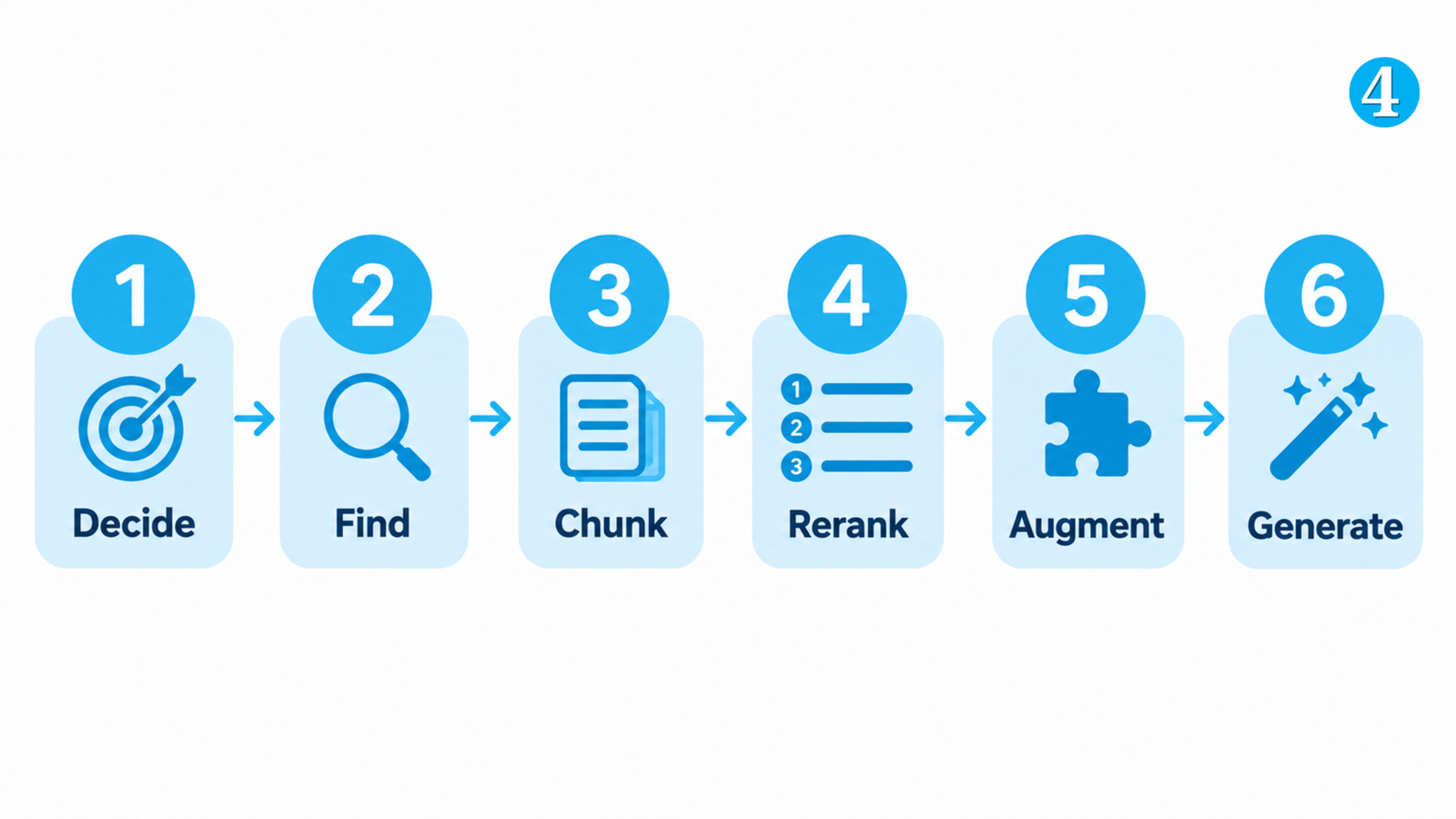
Real systems vary, but a typical RAG pipeline follows these stages.
1. Decide whether to retrieve
Not every question triggers a search. A system may answer simple or timeless questions from the model alone and retrieve only when it needs fresh or specific information.
2. Find candidate content
The retriever searches for documents or passages that match the question. Many systems combine keyword matching with semantic search, where text is converted into numerical representations called embeddings so that passages with similar meaning can be found even when the wording differs.
3. Work with chunks, not whole pages
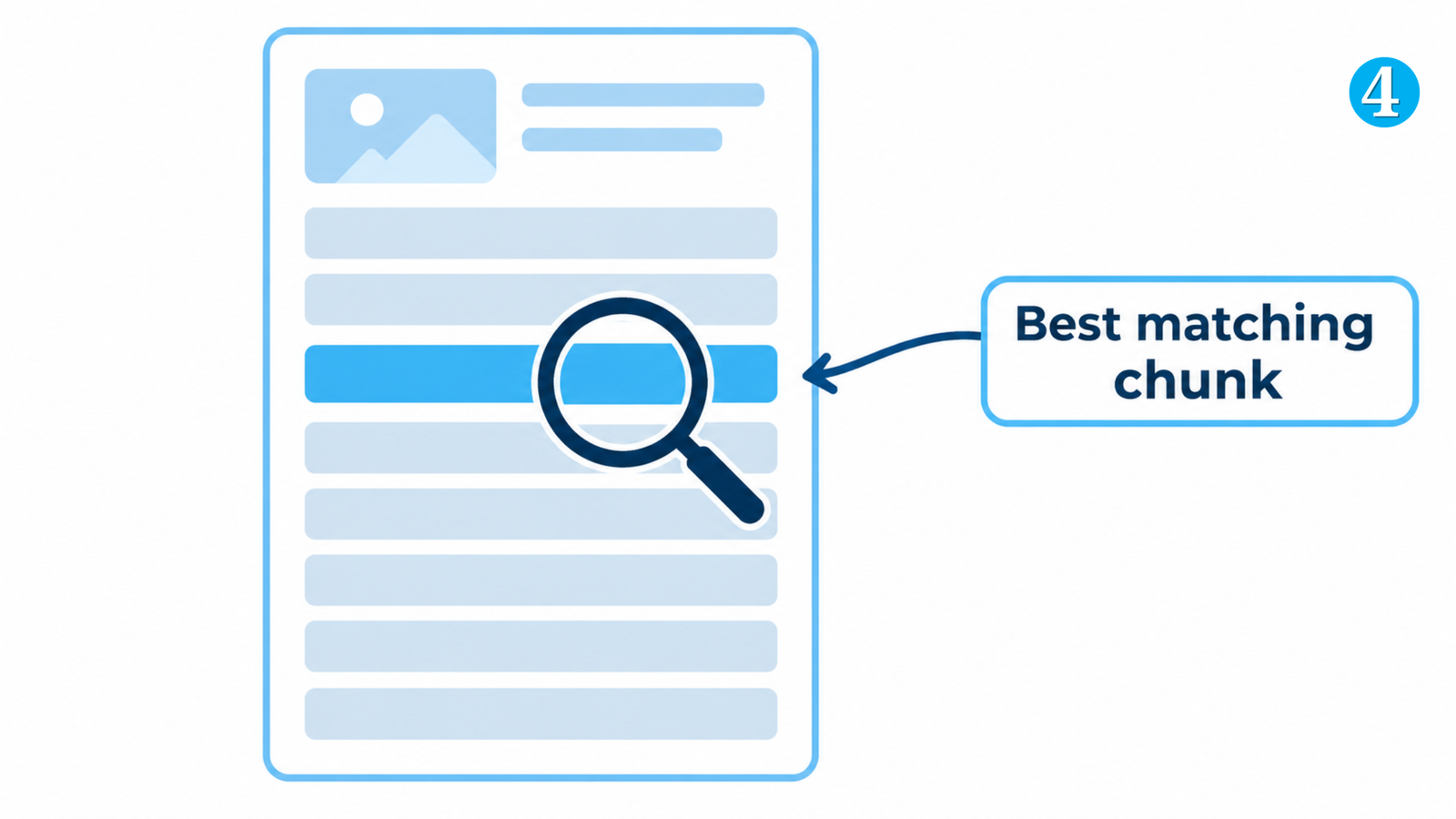
In typical RAG pipelines, long documents are split into smaller chunks, such as a few paragraphs, so the system can retrieve the exact piece that answers the question. This is the most practical point for writers. Your page may be judged one section at a time, not as a whole.
4. Rerank the results
The first set of matches is often reordered by a second step that scores which passages answer the question best. Only the top few usually move forward.
5. Augment the prompt
The selected passages are inserted into the prompt alongside the user’s question. This is the augmentation step. The model now has fresh evidence to work from.
6. Generate the answer
The model writes a response grounded in those passages, and many AI search products attach citations so users can check the sources.
What Is Documented and What Is Assumed
This is the part most guides skip. Google, Microsoft, and OpenAI all describe the general retrieve-then-generate approach behind their AI search products. None of them publish how sources are selected inside that loop.
That means any advice about optimising for retrieval, including the advice in this guide, is informed inference built from how RAG systems work in general, plus observation of what tends to get cited. It is reasonable and testable. It is not a confirmed ranking formula.
Be careful with confident claims about specifics, such as exact chunk sizes or whether a given product maintains its own index of the web. Consumer AI search products differ in how they work, and their internals are not public.
How Different AI Search Products Use Retrieval
- Google AI Overviews: summaries are built on top of Google’s own search systems, so strong traditional SEO and Google’s rendering and indexing still apply
- ChatGPT search: OpenAI describes it as drawing on third-party search providers and partner content to find current information and cite sources
- Perplexity: built around real-time web retrieval, with answers that show the sources used
The common thread is that each system needs to find a page, read it, and extract a usable answer from it. That is where your control begins.
What Makes Content Easier to Retrieve
Given how retrieval works, these habits tend to help. Each one maps to a stage of the pipeline.
| Pipeline stage | What you can do |
| Access | Allow retrieval crawlers in robots.txt and keep key content in the server-delivered HTML |
| Matching | Use headings that mirror real questions, and use the terms your audience actually uses |
| Chunking | Make each section self-contained, so a passage makes sense when read on its own |
| Reranking | Put a direct answer in the first sentences of a section, then support it |
| Trust | Show clear authorship, specific facts, and visible dates, and keep pages updated |
Write passages that survive being separated
If a paragraph only makes sense after reading the three before it, a chunk containing it will read poorly in isolation. Name the subject in the paragraph itself instead of relying on “this” or “it” pointing back to something earlier.
Answer first, explain second
A section that opens with the answer gives both a reranker and a reader something to lock onto. Burying the point in the fourth paragraph reduces the chance that the right passage scores well.
Be specific
A named method, a concrete number with a source, or a worked example gives a model something distinctive to cite. Generic statements that could appear on any site give it no reason to choose yours.
Common Mistakes
- Blocking retrieval bots in robots.txt while meaning only to block training crawlers. The two serve different purposes, and blocking retrieval removes you from live AI answers
- Loading main content through JavaScript, which many non-Google crawlers are reported not to run
- Vague headings such as “Overview” or “More Information” that tell a retriever nothing
- Long sections that mix several topics, so no single passage answers a single question
- Stale pages with no visible date, which look unreliable when freshness matters
- Assuming a top Google ranking guarantees retrieval. Ranking and retrieval overlap but are not the same system
RAG vs Traditional SEO
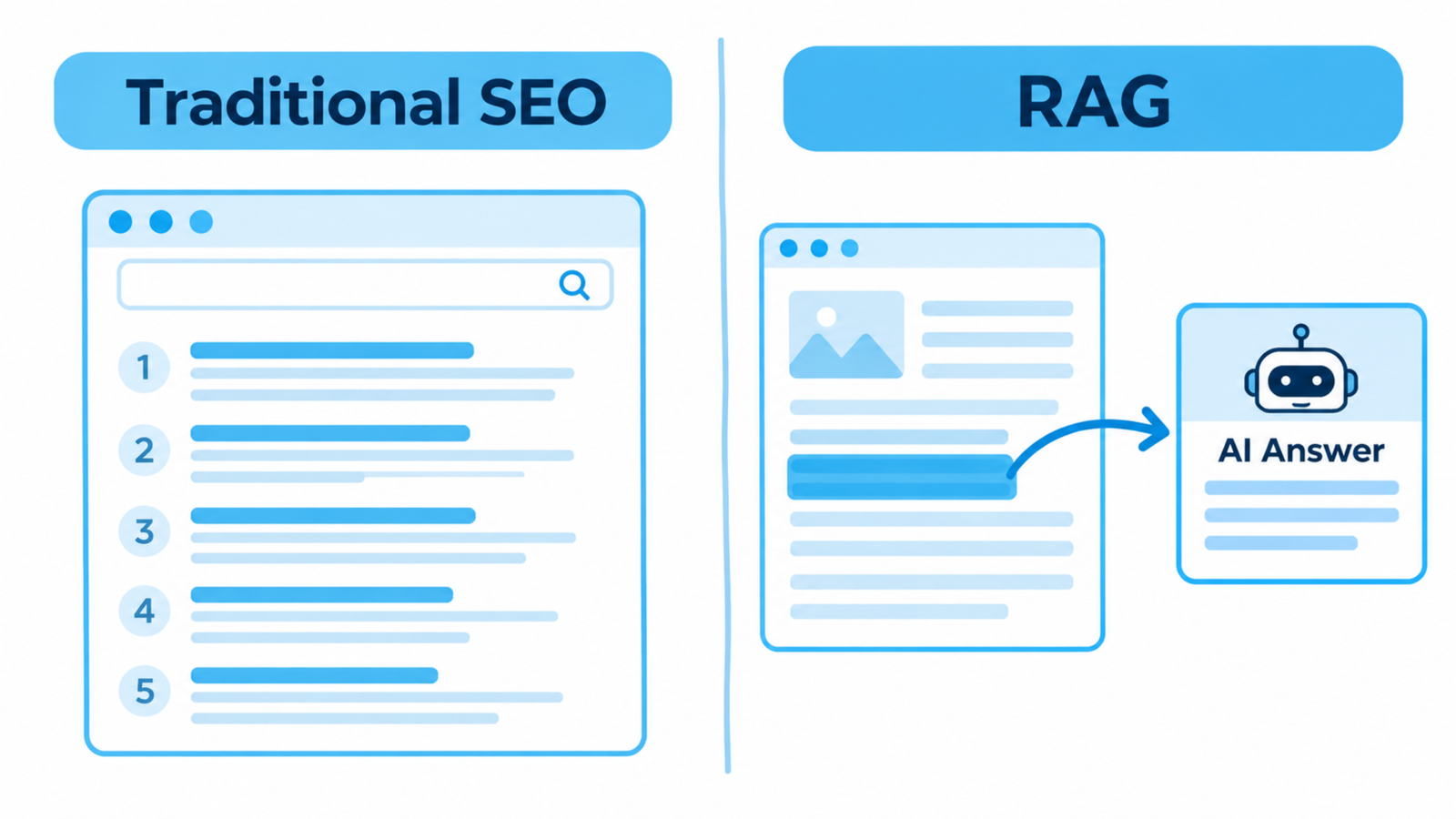
Traditional SEO asks whether a page can rank in a list of links. RAG asks whether a passage can be pulled out and used to build an answer. The two share foundations: crawlable pages, clear topics, and real authority. They differ in the unit being judged, which is a whole page in one case and a section of a page in the other.
This is why the habits that improve readability and on-page structure also improve retrievability. Clear headings, direct answers, and short focused paragraphs serve readers, ranking systems, and retrieval systems at once.
How to Check Whether You Are Being Retrieved
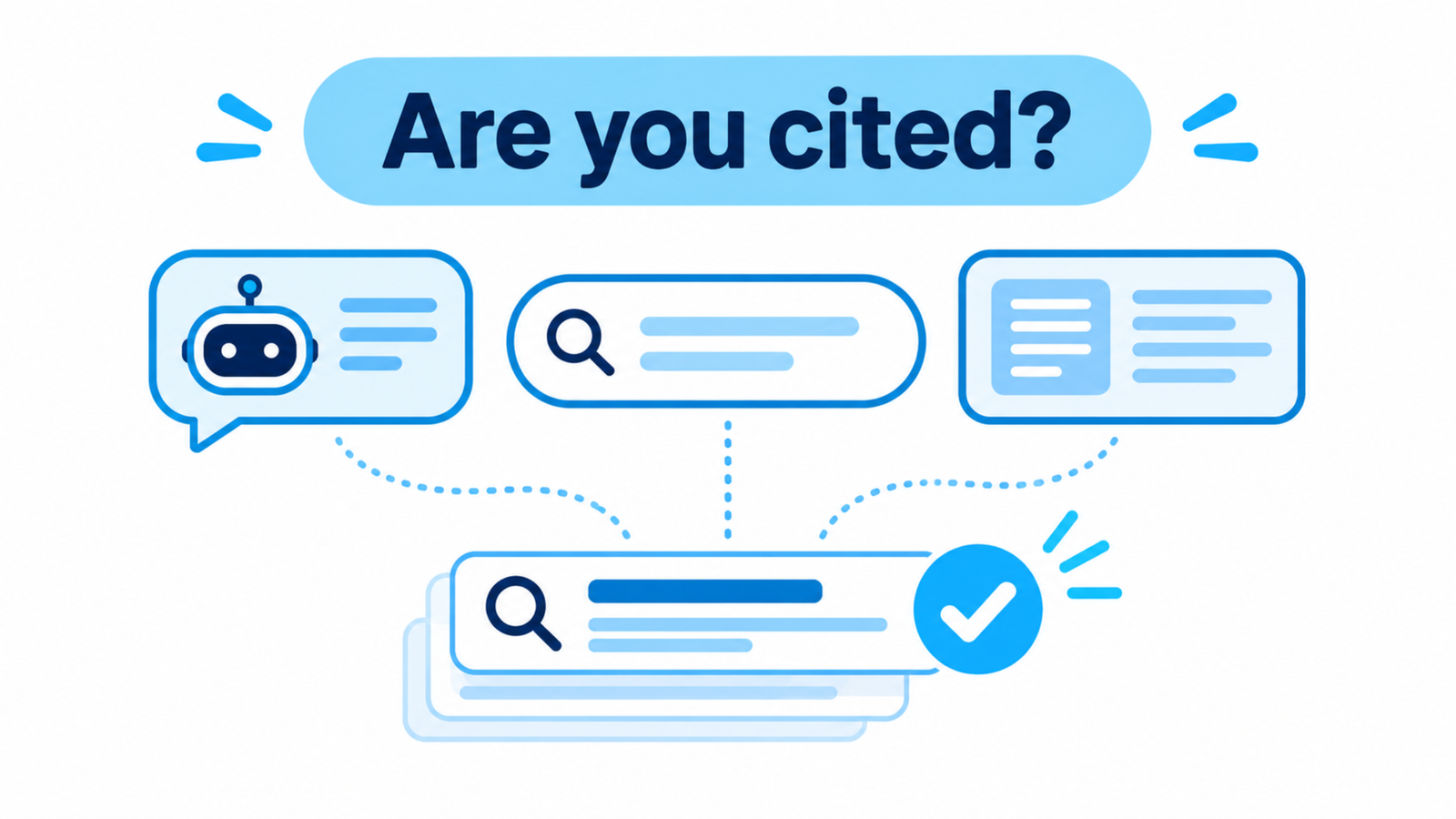
- Ask ChatGPT search, Perplexity, and Google AI Mode the questions your pages answer, and note which sources they cite
- Look for your domain and your competitors’ domains in the citations, and read the cited passages to see what they have that you lack
- Repeat monthly with the same questions to spot changes over time
- Read your own key paragraphs in isolation. If one does not make sense without context, rewrite it to stand alone
- Review Search Console for queries and pages gaining impressions, as a check that the page is being found at all
Final Thoughts
RAG is not mysterious once you see the loop: retrieve passages, add them to the prompt, generate an answer. The visibility question for publishers comes down to whether your content gets retrieved at the first step.
You cannot control the systems, and nobody outside them can promise exact rules. You can make your pages accessible, answer-first, specific, and easy to read in sections, and then test what gets cited. That approach costs little and stays useful however the systems change.
1 thought on “What is RAG? How AI Search Engines Retrieve Content”
Comments are closed.