
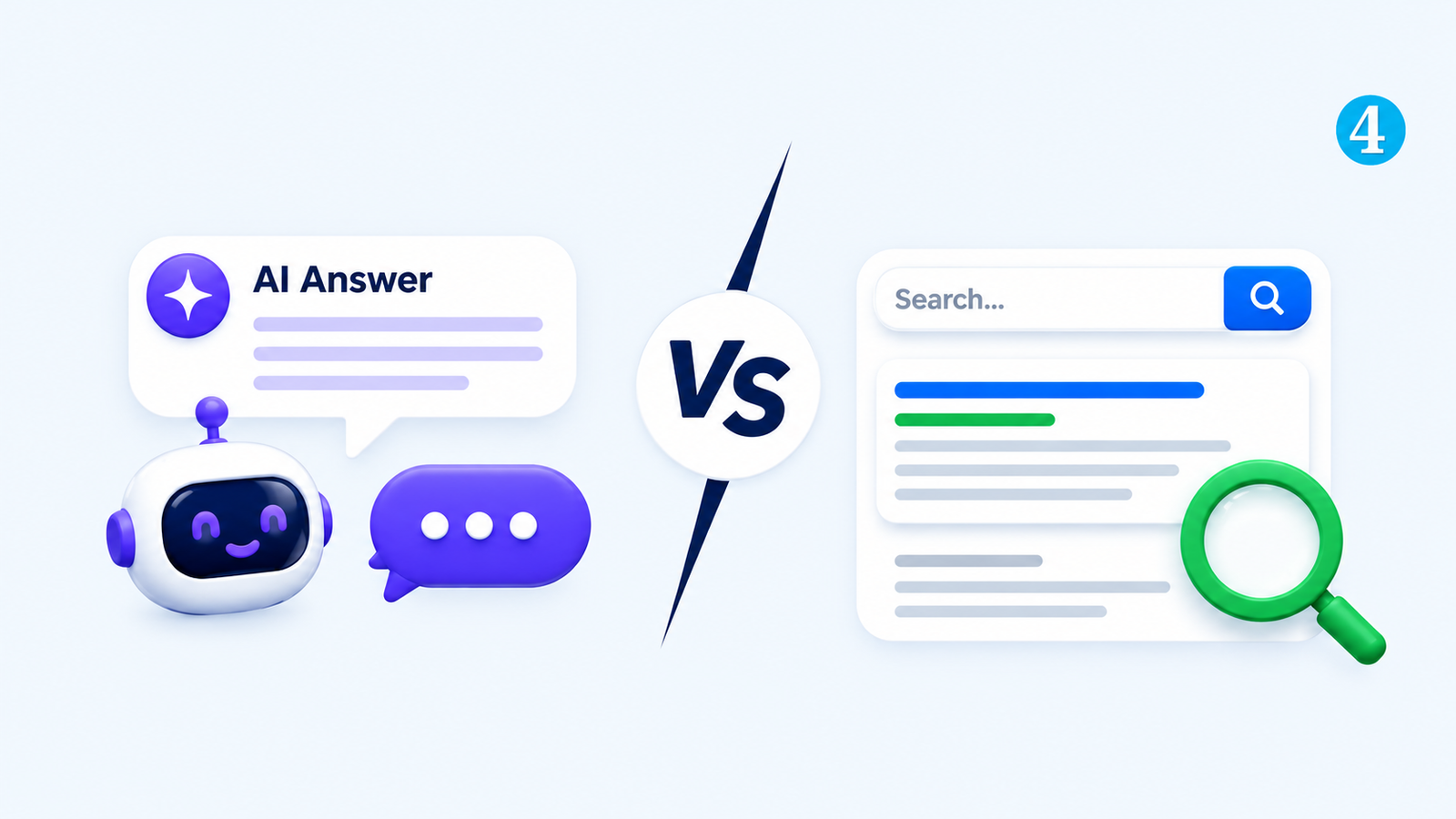
If people are increasingly using ChatGPT and other AI tools to find information, does that mean traditional SEO is becoming less valuable?
Not necessarily.
AI-powered search is changing how people discover information, compare options and make decisions. But SEO still plays an important role in helping search engines discover and rank useful content.
Generative Engine Optimisation (GEO) focuses on improving how a brand’s information can be discovered, understood and potentially referenced in AI-generated answers.
The two approaches overlap in several important ways. Both benefit from useful content, accessible websites and reliable information.
The main difference is what you’re measuring. With SEO, you typically focus on search visibility, website traffic and conversions. With GEO, you also look at how your brand appears in AI-generated answers, whether your website is cited and how accurately AI systems describe your business.
For most businesses, the practical approach is to build a strong SEO foundation while monitoring visibility across relevant AI search experiences. You usually don’t need two completely separate content strategies.
What Is SEO?
Search engine optimisation (SEO) is the process of improving a website’s visibility in organic search results.
When someone searches for a product, service or question related to your business, you want the relevant page to appear in search results and provide a compelling reason to visit your website.
SEO typically involves several areas:
- Technical SEO: Making important pages accessible, crawlable and eligible for indexing.
- On-page SEO: Improving page titles, headings, internal links and content relevance.
- Content quality: Providing useful, accurate information that satisfies the reader’s needs.
- Authority and reputation: Building credibility through original work, relevant references and genuine recognition.
- Performance measurement: Monitoring impressions, clicks, organic traffic, leads and conversions.
The goal isn’t simply to attract more visitors. It’s to connect the right people with the right information and help them take a meaningful next step.
What Is GEO?
GEO is a term used to describe efforts to improve the visibility of information in AI-generated search and answer experiences.
The term was used in the 2023 research paper GEO: Generative Engine Optimization, which investigated methods for improving content visibility in generative search engines.
In practice, GEO involves examining how AI systems respond when people ask questions related to your business or industry.
For example, an AI-generated answer might:
- Mention your company when recommending relevant services.
- Cite one of your website pages as a source.
- Reference a statistic from your original research.
- Use information about your products to compare available options.
- Answer a question using your content without generating a direct visit to your website.
These outcomes are not guaranteed, and different platforms can produce different answers.
A useful starting point is this: SEO focuses on organic search visibility, while GEO adds a focus on visibility and representation in AI-generated answers.
The two are closely related, and many activities that support SEO can also help make your content accessible to AI-powered search systems.
GEO vs SEO: What’s the Difference?
1. The outcomes you measure are different
With traditional SEO, you might measure whether a page ranks for a target query, attracts organic clicks and generates leads.
AI-generated answers introduce additional ways to assess visibility.
Your company might be mentioned in an answer, your website might be cited, or a competitor might be recommended instead. A user could also receive the information they need without visiting any website.
This means website traffic remains important, but it doesn’t capture every way people encounter your brand.
SEO reporting can help you understand organic search performance. GEO monitoring can complement it by examining brand mentions, citations, accuracy and competitor visibility across selected AI platforms.
2. People can discover information differently
Traditional search results often present a list of pages that users can open and compare.
AI assistants can instead combine information from multiple sources into a single response, sometimes with links to supporting pages.
This can make research more convenient for users, but it also changes how businesses think about visibility.
A company might be represented in an AI answer even when the user doesn’t click through to its website. Conversely, a page that performs well in traditional search may not appear in a particular AI-generated answer.
Neither outcome alone tells you the full story. Both search performance and AI visibility need to be considered in the context of your business goals.
3. Clear, verifiable information matters
SEO content should already answer questions clearly and accurately. These principles also make content more useful when AI systems retrieve and summarise information.
The second statement is more specific, provided the statistic is accurate and the source supports it.
Whenever you publish an important claim, give readers enough context to understand it. Include relevant dates, explain what the figures measure and link to reliable sources where appropriate.
Original research, first-hand experience and detailed examples can also help distinguish your content from pages that simply repeat widely available information.
There is no single, universally applicable checklist of GEO ranking factors for every AI platform. Each system has its own methods for discovering and selecting information, and its complete ranking mechanisms aren’t publicly documented.
Rather than relying on unsupported optimisation tricks, focus on content quality, technical accessibility, source reliability and the needs of your audience.
4. GEO measurement is less straightforward
SEO has established reporting tools for measuring impressions, clicks, rankings and conversions.
Measuring visibility across AI platforms is more complicated because answers can vary by prompt, context, platform and time.
A practical starting point is to create a consistent set of questions that your customers are likely to ask. Run them across the AI platforms relevant to your audience and record what happens.
For each test, note:
- Whether your brand appears.
- How the AI describes your business.
- Whether the information is accurate.
- Whether your website is cited.
- Which other sources are referenced.
- Which competitors appear in the answer.
Repeat the tests periodically and record the dates and platforms used. This won’t provide a complete measurement of every AI interaction, but it can help identify patterns and opportunities for further investigation.
GEO vs SEO in Practice: Google, ChatGPT, Perplexity and Claude
There isn’t one universal AI search system. Different platforms have different products, crawlers and methods of accessing information.
Understanding those differences can help you make better technical decisions.
Google AI Overviews and AI Mode
Google’s AI search features are built on its broader Search systems.
According to Google’s official guidance on AI features, existing SEO best practices remain relevant. Pages must meet the applicable technical requirements and be eligible to appear in Google Search to be considered for inclusion in AI Overviews and AI Mode.
Google doesn’t require special GEO markup or separate AI-specific files for these features.
For website owners, the priorities remain familiar:
- Make important pages accessible to Googlebot.
- Ensure useful content can be discovered and indexed.
- Provide clear, reliable information.
- Use structured data appropriately when relevant.
- Monitor organic search performance through Search Console.
Meeting these requirements doesn’t guarantee that a page will appear in an AI-generated answer.
ChatGPT
OpenAI documents different crawlers for different purposes.
OAI-SearchBot is used to help surface websites in ChatGPT search results. GPTBot is associated with crawling content that may be used to train OpenAI’s generative AI foundation models.
These controls are separate. A website owner can allow OAI-SearchBot while disallowing GPTBot, depending on the site’s preferences.
If visibility in ChatGPT search matters to your business, review your robots.txt rules and OpenAI’s current crawler documentation before making changes.
Perplexity
Perplexity documents its own crawler, PerplexityBot, for discovering web content used in its search experience.
Website owners should consult Perplexity’s official documentation to understand the relevant crawler controls and access requirements.
Avoid assuming that every AI platform uses the same crawler rules or responds to them in the same way.
Claude
Anthropic also documents different crawlers and user agents for different purposes, including ClaudeBot, Claude-SearchBot and Claude-User.
Their functions aren’t interchangeable. For example, a crawler associated with training doesn’t necessarily serve the same role as one associated with search or user-requested retrieval.
Check Anthropic’s documentation for current details before changing your website’s crawler settings.
The broader lesson is simple: understand what each crawler does before deciding whether to allow or block it.
An old robots.txt rule that blocks all AI-related crawlers might not reflect your current business preferences. However, changing these rules should be a deliberate decision, not an automatic SEO tactic.
Does Traditional SEO Still Matter?
Yes. SEO remains an important foundation for organic search visibility, including Google’s AI search features.
Crawlability and indexing
Start by making sure your important pages can be discovered and processed.
Review robots.txt, indexing directives, internal links and other technical settings. Check whether important content is available in a form the relevant search system can access.
JavaScript-heavy websites may require additional testing to ensure important content is rendered and available as intended.
Remember that crawling, indexing and appearing in search results are different things. Allowing a crawler to access a page doesn’t guarantee that the page will be indexed or selected for an answer.
Structured data
Structured data provides a standardised way to describe information on a page.
Depending on the website, relevant types might include Organization, Article or Product structured data.
Use structured data when it accurately represents the visible content and supports an appropriate search feature. Validate the implementation and keep it consistent with the information users can see.
Don’t treat schema as a shortcut to AI visibility. Google explicitly states that there is no special structured data requirement for appearing in AI Overviews or AI Mode.
Helpful content and credibility
A technically accessible page can still be unhelpful.
Good content should answer the reader’s question, explain important details and provide reliable evidence for significant claims.
First-hand experience, original research, relevant examples and expert insight can make an article more useful than a generic summary of information already available elsewhere.
These principles support a sustainable content strategy regardless of whether a visitor arrives through traditional search or an AI-powered experience.
How to Optimise Content for SEO and GEO
You usually don’t need one version of an article for Google and another for ChatGPT.
Instead, build a useful page that answers the reader’s question and makes important information easy to find and verify.
Answer the main question early
Give readers a clear answer near the beginning of the page.
Follow it with the context, examples and supporting details they need to understand the topic.
This makes the article easier to navigate and helps readers identify the information most relevant to them.
You don’t need to force every possible search query into a heading. Use natural language that reflects the questions your audience actually asks.
Support important claims with evidence
Specific claims are more useful when readers can check them.
If you say revenue increased by 25%, explain which revenue figure you’re discussing, what periods you’re comparing and where the data came from.
Prefer original research, official documentation and other reliable primary sources when they support the claim.
If a statement is an estimate, explain that. If the evidence is incomplete, don’t present an assumption as a confirmed fact.
Use descriptive headings
Headings should help readers understand the structure of the page.
For example, a heading such as “How do you measure GEO?” tells the reader exactly what the next section covers.
Use headings where they improve navigation and clarity. Avoid adding repetitive headings solely to include more keywords.
Keep your brand information consistent
Make sure your business name, products, services and other important identifying details are accurate across your website and relevant external profiles.
Review your:
- Website and Organization structured data.
- Industry directories and business profiles.
- Review platforms and social profiles.
- Relevant third-party publications.
Consistency can help reduce confusion about your business, although it doesn’t guarantee that an AI system will mention or recommend you.
Publish original research and useful expertise
Your website isn’t the only source an AI system may use.
Relevant third-party publications, original studies, expert interviews and other credible sources can provide additional context about your business or industry.
If you have original data, explain how it was collected, what it shows and what its limitations are. Make the findings easy for readers to understand and reference.
The goal is to create something genuinely worth citing, not to manufacture brand mentions or pursue links without regard to quality.
Review crawler rules
Check your robots.txt file periodically, particularly when your approach to AI search or model training changes.
Some businesses may want to allow crawlers associated with search while restricting those associated with training. Others may choose different settings.
Review each platform’s current documentation and consider the implications before making changes. Blocking a crawler can affect the relevant service’s ability to discover or retrieve your content.
How to Measure GEO
There isn’t one universal reporting method that captures visibility across every AI platform. Start with a simple, repeatable process.
Create a set of around 20–30 questions that potential customers might ask. Treat this number as a practical starting point, not an official industry standard.
Include questions about:
- Your products or services.
- Common customer problems.
- Comparisons and buying decisions.
- Your industry and its trends.
- Your brand and relevant competitors.
Run the same prompts on the platforms that matter to your audience. Record the platform, date, exact prompt and response.
Track the following:
| What to measure | Why it matters |
| Brand mentions | Shows whether your business appears in the tested answers. |
| Brand descriptions | Helps you assess how the AI represents your business. |
| Accuracy | Identifies incorrect or outdated information. |
| Website citations | Shows whether your pages are referenced as sources. |
| Other cited sources | Helps identify which sources are being used instead. |
| Competitor mentions | Reveals which alternatives appear in the same answers. |
Repeat the tests periodically under reasonably consistent conditions.
AI responses can change, so don’t treat a single result as proof that your GEO strategy is succeeding or failing. Look for patterns over time and investigate meaningful changes.
For Google Search specifically, use Search Console to monitor organic search performance, and review the available reporting for AI search features. Complement those metrics with conversions and business outcomes in your analytics tools.
A Practical GEO vs SEO Checklist
Use this checklist during a monthly review:
- Check that important pages are accessible, indexable and free of major technical issues.
- Review robots.txt and compare your rules with the current documentation for relevant AI platforms.
- Validate relevant structured data and confirm that it matches visible content.
- Review the opening of important pages to ensure each answers its main question clearly.
- Check statistics, quotations and factual claims against reliable sources.
- Run your selected prompts across the AI platforms relevant to your audience.
- Record brand mentions, citations, accuracy and competitor visibility.
- Compare results over time and investigate significant changes.
- Review organic traffic, leads and conversions alongside AI visibility.
- Update your content when you identify a genuine information gap or a change in the evidence.
A spreadsheet is enough to get started. A more complex dashboard is only worthwhile when it helps you make better decisions.
A Practical GEO vs SEO Example
Imagine a B2B software company has published a guide targeting the question “What is SEO?”
The page ranks third in Google for a relevant query, and the marketing team considers it successful.
However, when they test related questions in ChatGPT and Perplexity, competitors appear more often in the answers.
Instead of immediately publishing another article, the team reviews its existing guide.
They discover that the main definition is buried in the introduction, some statistics lack clear sources, and the article doesn’t explain the company’s original research particularly well.
The team also checks its technical setup to confirm that relevant crawlers can access the pages intended for AI search.
They then make several improvements:
- Move the definition closer to the beginning.
- Add reliable sources for important statistics.
- Explain the original research and its methodology.
- Review structured data and crawler settings.
- Share the research with relevant industry publications where appropriate.
None of these changes guarantees an AI mention.
However, they improve the clarity and usefulness of the page while addressing potential technical barriers.
The team continues testing the same questions over the following months. If the company still doesn’t appear in the answers, it can investigate which sources are being used instead and whether the content needs further improvement.
This is a more useful approach than publishing additional pages without first understanding the problem.