
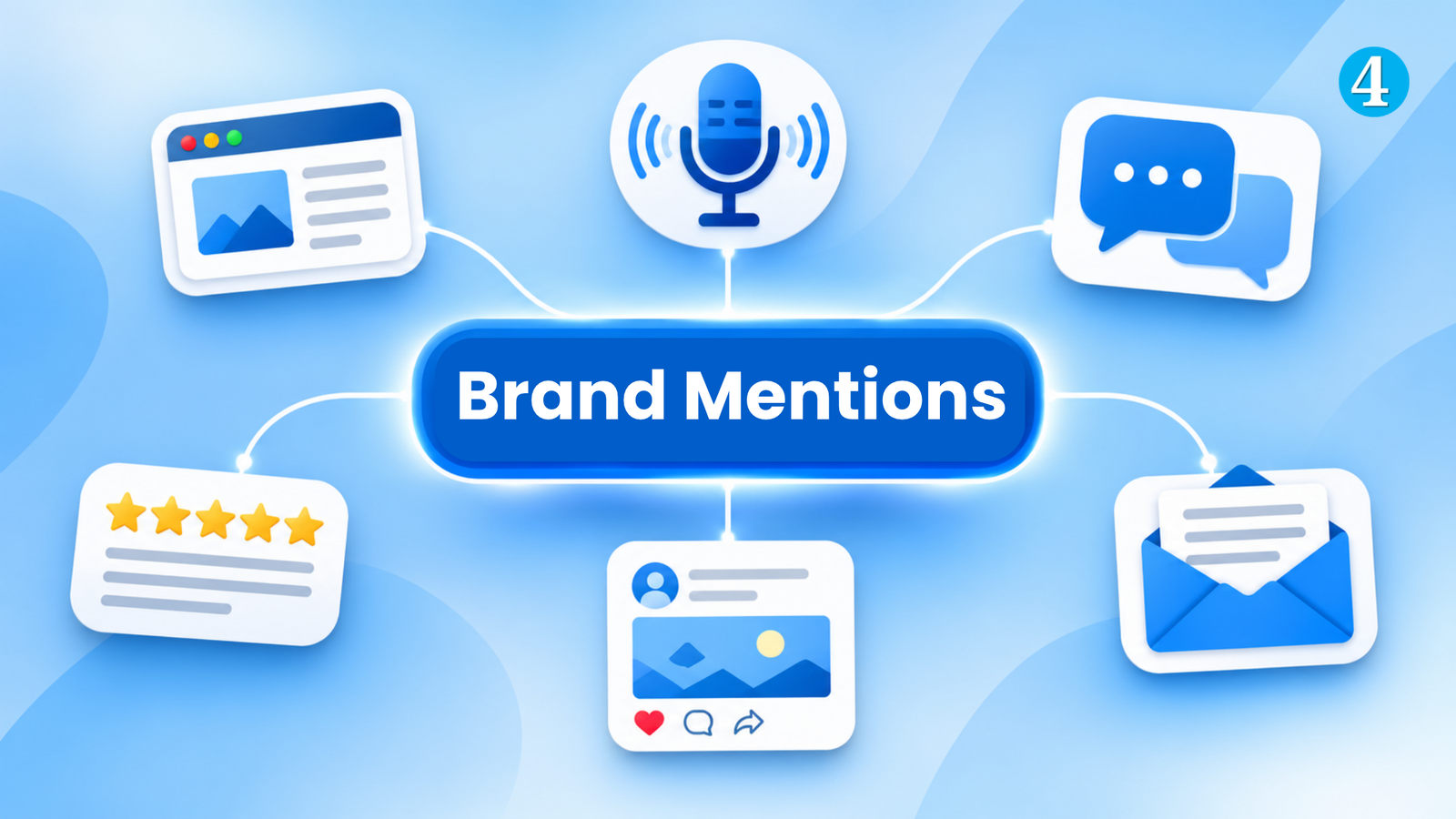
For years, off-page SEO revolved around one major factor: backlinks. If another website linked to your site, it created a pathway for referral traffic and could contribute to search rankings. If another website simply mentioned your brand without linking to it, its SEO value was less understood. Today, that picture is more nuanced, especially for newer websites competing against established brands.
Search engines and AI tools increasingly work with entities: identifiable people, businesses, products, and organisations connected to relevant topics and information. Brand mentions and entity signals help establish these connections across the web. This guide explains what they are, how they work, what is supported by official documentation, and how to build them strategically.
What Brand Mentions Are
A brand mention is any reference to your brand name, product, or founder on a website or platform you do not own. It can appear in an article, podcast transcript, forum discussion, customer review, or social media post.
Brand mentions generally come in two main forms. A linked mention includes a hyperlink to your website. An unlinked mention refers to your brand in plain text without a hyperlink. A third form is worth understanding: an implied reference, where someone discusses your product or service without explicitly naming your brand.
Quick example: A blogger writes, “I learned most of my technical SEO from 4SEOGuide.” There is no hyperlink, just the brand name. This reference provides contextual information about your brand and its association with the SEO topic, although its direct impact on search rankings or entity recognition is not publicly established.
What an Entity Is, and What Entity Signals Do
An entity is a distinct and identifiable thing that search engines can understand, such as a person, company, product, or place. Google’s Knowledge Graph connects entities with relevant information and relationships. When Google recognises your brand as an entity, it can associate your name with your website, industry, and other relevant information rather than treating it as an isolated text string.
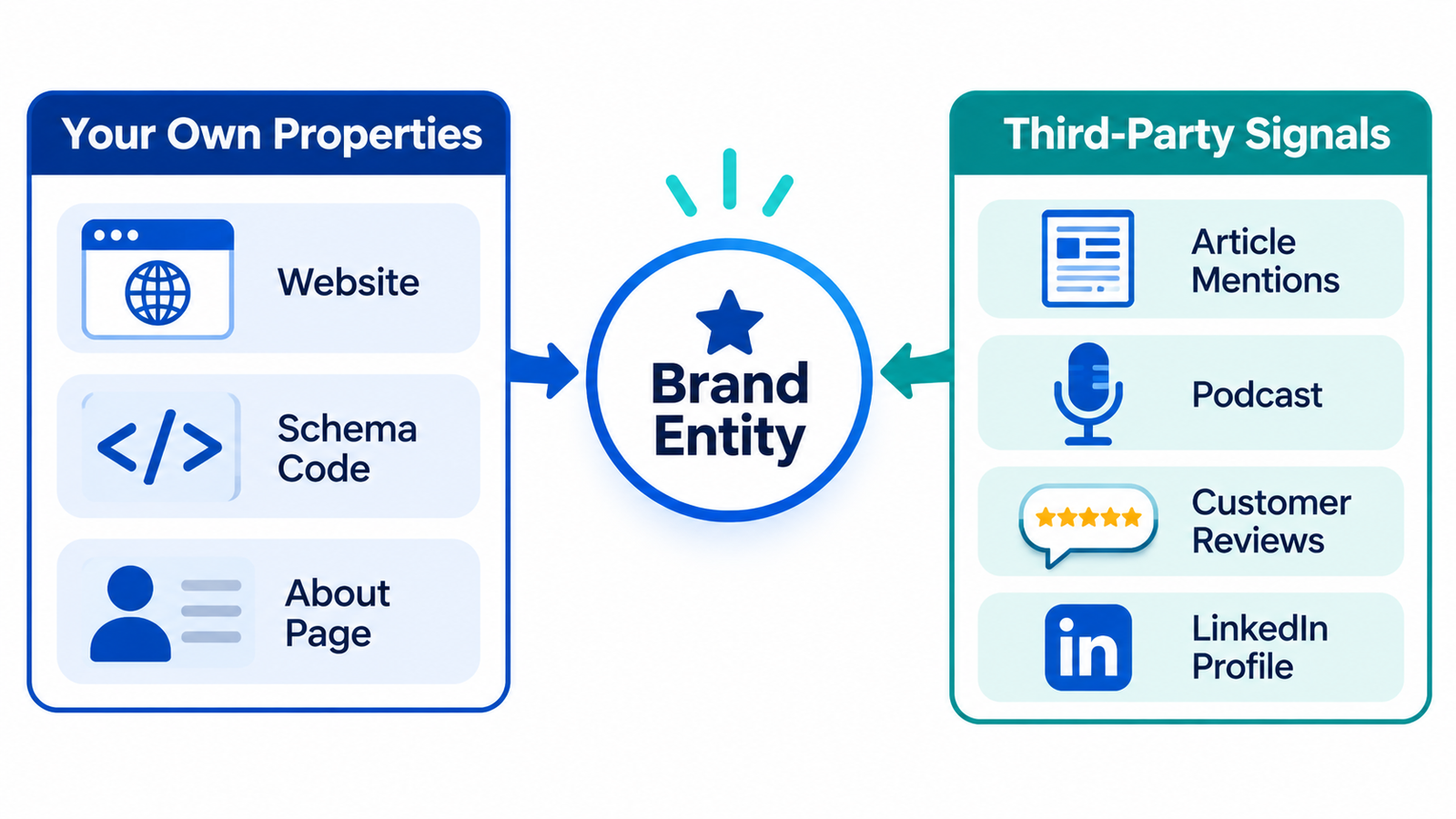
Entity signals are the information and references that help search engines understand and distinguish these identities. They fall into two groups.
Signals on your own properties
- Consistent brand naming across your website, social profiles, and business listings
- Organization schema markup that identifies your business and connects its official profiles
- A detailed About page and author profiles with verifiable information
Signals from third parties
- Mentions in relevant articles, industry roundups, podcasts, and forum discussions
- Co-occurrence: your brand appearing alongside recognised names, products, and topics in your industry
- Customer reviews and the sentiment expressed in them
- Profiles on relevant platforms such as LinkedIn that identify your brand and link to your website
Third-party references can provide independent context about your brand. However, their value depends on relevance, credibility, and the accuracy of the information rather than simply the number of mentions.
Why This Matters in 2026
Two developments make entity understanding increasingly relevant. First, Google’s systems can interpret context, relationships, and the meaning behind content, rather than relying only on individual keywords. Second, AI search tools such as ChatGPT, Perplexity, and Google’s AI Overviews can reference information from multiple sources when generating answers and identifying relevant brands.
Consistent brand information across credible, independent sources may support discoverability across these platforms. However, AI providers do not fully disclose their selection and citation mechanisms, and brand mentions alone do not guarantee visibility in AI-generated answers.
An important distinction: Google has not published a formula assigning a specific ranking value to unlinked brand mentions. Much of the discussion around their SEO impact comes from patents, industry research, and practitioner observations. The sensible approach is to treat mentions as a supporting part of brand-building and off-page SEO, not as a confirmed standalone ranking factor.
| Factor | Linked Mention | Unlinked Mention |
| Referral traffic | Readers can click through | No direct click path |
| Link authority | May contribute to link-based ranking systems | Does not pass link equity |
| Brand context | Helps establish brand associations | Can provide contextual brand information |
| Common sources | Editorial websites and industry publications | Forums, podcasts, reviews, and social posts |
These two types serve different purposes. Linked mentions can generate referral traffic and contribute to traditional link-based SEO, while unlinked mentions can increase brand exposure and provide additional context. A balanced brand-building strategy can include both.
How to Strengthen Your Own Entity Signals First
Before pursuing third-party mentions, make sure your brand identity is consistent across your own properties. Search engines need clear and accurate information to distinguish your brand from other businesses with similar names.
Pick One Name and Use It Everywhere
If your brand appears as “4SEOGuide” on one platform, “4 SEO Guide” on another, and “4seoguide.com” on a third, these variations may make brand identification less straightforward. Choose one primary brand name and use it consistently across your website, social profiles, author bios, and relevant business listings.
This becomes especially important when another business operates under a similar name. Consistent branding helps reduce confusion and makes your online identity easier to recognise.
Add Organization Schema With sameAs
Organization schema helps search engines understand your official business name, website, and relevant profiles. The sameAs property connects your website with other official online identities, such as your LinkedIn and Instagram profiles.
Rank Math can generate Organization structured data through its settings, or you can implement it manually:
json
{
“@context”: “https://schema.org”,
“@type”: “Organization”,
“name”: “4SEOGuide”,
“url”: “https://4seoguide.com”,
“sameAs”: [
“https://www.linkedin.com/company/your-brand”,
“https://www.instagram.com/your-brand”
]
}
Use only official profiles that genuinely represent your organization. Structured data helps Google understand and distinguish your business, but it does not guarantee higher rankings or a Knowledge Panel.
Make Authors Real Entities Too
A named author with a professional biography, photograph, and links to relevant profiles provides readers with information about who created the content. Author pages can establish connections between individuals, their expertise, and their published work.
Use accurate author details, relevant professional experience, and verifiable credentials rather than generic or anonymous bylines.
How to Earn Brand Mentions
Brand mentions are most valuable when they result from useful contributions, original information, and genuine industry recognition. Focus on creating something that other people have a reason to reference.
- Publish original research, useful data, or a distinctive framework. A well-supported statistic, survey, or practical methodology gives other websites something valuable to reference.
- Contribute expert comments to journalists, industry newsletters, and relevant roundups.
- Write guest articles and appear on industry podcasts. These opportunities can introduce your brand to new audiences and generate relevant mentions.
- Participate in communities where your target audience already engages, including relevant forums and professional groups. Provide useful answers before introducing your brand.
- Encourage genuine customer reviews on relevant platforms and respond professionally to feedback.
Consistency matters more than occasional promotional spikes. A single major publication feature can increase exposure, but ongoing recognition across relevant and independent sources helps establish a clearer picture of your brand.
How to Find and Track Mentions
- Set up Google Alerts for your brand name, common variations, and founder’s name to discover new references.
- Search your brand name in quotation marks on Google and review results beyond the first page for unlinked mentions.
- Monitor branded queries in Google Search Console. Changes in branded impressions and clicks can provide useful indications of growing brand awareness.
- Check ChatGPT, Perplexity, and Google AI search experiences using relevant questions your customers might ask. Record whether your brand appears and repeat the checks periodically.
- Consider a brand monitoring tool if your budget allows. For smaller websites, a consistent manual monitoring routine can provide a useful starting point.
Turning Unlinked Mentions Into Links
When you discover a relevant page mentioning your brand without a link, consider contacting the publisher with a short, friendly message. Thank them for mentioning your brand, identify the specific reference, and suggest your website as a useful destination for readers.
Some publishers may be willing to add a link, while others may prefer to keep the original reference unchanged. Respect their decision. An unlinked mention can still provide brand exposure, even though it does not pass traditional link equity.
Common Mistakes
- Inconsistent naming across platforms: Different brand variations can make your identity less straightforward to recognise.
- Focusing only on backlinks: Traditional links remain important, but brand visibility and independent references also deserve attention.
- Buying low-quality mentions: Paid placements on irrelevant or untrustworthy websites can damage credibility and may create link spam risks.
- Ignoring sentiment: A critical review can increase brand visibility while negatively affecting customer trust. Respond constructively to genuine feedback.
- Expecting immediate results: Building brand recognition and a consistent online presence takes time. Focus on sustainable improvements rather than short-term changes.
Final Thoughts
Brand mentions and entity signals support a simple principle: build a brand that people naturally recognise and reference when discussing your industry. Backlinks remain valuable, but they are only one part of a broader approach to online visibility and brand recognition.
Start with what you can control: consistent brand naming, accurate Organization schema, and credible author profiles. Then focus on earning relevant mentions through original work, useful contributions, and genuine industry relationships. Neither requires an unnecessarily large budget, but both demand consistency and patience.